With over twenty years of experience, Insul.Tecno Group is a leading supplier of high-performance thermal insulation materials and components. From aerospace to transportation to industrial applications, the company supports the development of complex projects with customized solutions that ensure high heat resistance, durability, and reliability.
Among the materials used, 3M™ Nextel™ ceramic fibers and textiles stand out, renowned for their excellent performance in extreme environments. Insul.Tecno Group is the preferred converter and distributor for these products in Italy, used in technologically advanced contexts and critical operating conditions.
Over the years, the company took part in numerous projects, supplying technical materials, insulation systems, and custom components, contributing to the success of applications in technology-intensive sectors.
Here are some of the projects to which we have contributed as a technical partner and specialized supplier:
1 – LOOPS-M
2 – Vega-C
3 – Mini-IRENE
4 – EFESTO-2
5 – JET NOISE REDUCTION

Intro
The LOOPS-M (Lunar Operative Outpost for the Production and Storage of Microgreens) project represents a significant contribution to food self-sufficiency in space, with a specific focus on sustainable microgreen production in extraterrestrial environments. The team is composed of master’s students from the Department of Astronautical Engineering at Sapienza University of Rome, in collaboration with doctoral students from ENEA (Italian National Agency for New Technologies, Energy and Sustainable Economic Development). The project was developed as part of the international initiative IGLUNA 2021, promoted by Space Innovation under the ESA_Labs@ program.
Context and Objectives
With the imminent construction of a permanent lunar base under NASA’s Artemis program, developing autonomous systems for the production and management of vital resources is a priority. LOOPS-M aims to:
- Build a closed, vertical, and highly efficient system for the automated cultivation of microgreens.
- Integrate a protection system against extreme lunar conditions.
- Implement an organic waste management solution through bioconversion, ensuring the circularity of resources.
Lunar Environmental Challenges
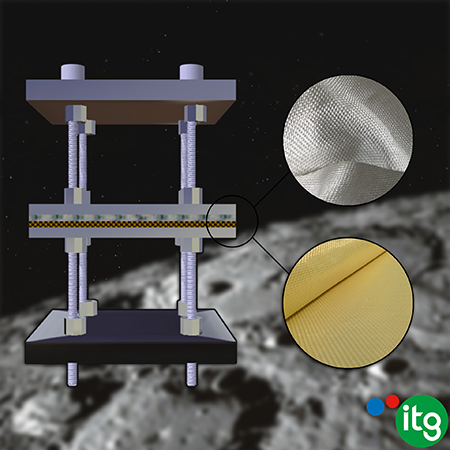
The lunar environment presents significant challenges: temperatures that can reach -230°C, exposure to cosmic radiation, and impacts from high-velocity micrometeorites. To address these conditions, the team designed a multilayer shielding system, based on a “padded” Whipple layout, optimized for hypervelocity impacts. The materials used include aluminum, aerogel, and special composites, with the goal of:
- Maintaining stable internal thermal conditions.
- Reducing the risk of structural damage to the outpost.
- Ensuring the safety of the lunar greenhouse.
A 10×10 cm² prototype was built and subjected to thermal vacuum and irradiation tests to validate its effectiveness in simulated lunar surface conditions.
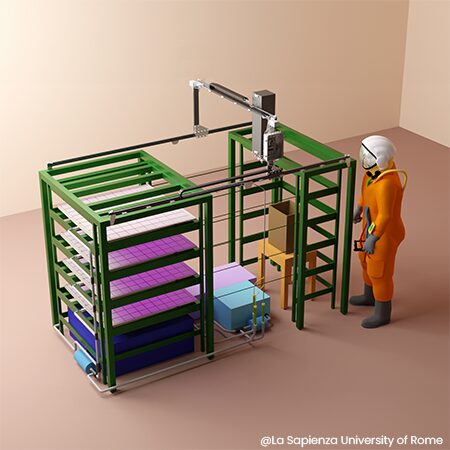
The Autonomous Cultivation System – HORT3 MKII
The core of the project is the HORT3 MKII automated cultivation system, an evolution of the prototype developed during the AMADEE-18 mission in the Omani desert. This new version:
- Uses a vertical hydroponic approach to maximize the use of space and resources.
- It is equipped with a multifunctional robotic arm, capable of performing agricultural tasks such as planting, irrigation, and harvesting.
- It minimizes human intervention, allowing astronauts to focus on mission-critical tasks.
The system was designed to operate both in space and on Earth, with potential applications even in urban environments on Earth.
Waste Bioconversion System
LOOPS-M also addresses the issue of organic waste management with an autonomous bioconversion unit. This unit uses black soldier fly (Hermetia illucens) larvae to naturally degrade agricultural residues (roots, substrate, hypocotyl):
- The waste is converted into nutrient-rich biomass.
- The resulting pupae can serve as an alternative protein source for astronauts.
- The system is completely autonomous, reducing the need for crew supervision.
Virtual Simulation and Validation
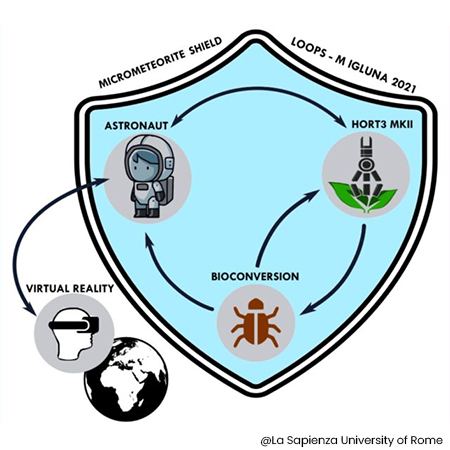
All subsystems—automated greenhouse, micrometeorite shield, and bioconversion module—were integrated into a virtual reality environment. This allowed for:
- Detailed visualization of the lunar outpost.
- Evaluation of the interaction between subsystems.
- Effective communication of results to an interdisciplinary audience.
Industrial Contribution: Advanced Materials for the Protection of the Lunar Module
The success of the LOOPS-M project was also made possible thanks to the collaboration with industrial partners who provided advanced materials essential for the construction of the micrometeorite shield prototype. Specifically, Insul.Tecno Group contributed high-performance technical fabrics, essential for ensuring resistance to hypervelocity impacts and thermal protection of the outpost.
The materials provided include:
- Nextel™ 312 fabric: an aluminum oxide-silica ceramic fiber highly resistant to high temperatures and fracture, used as a structural component in the shield layout. Its insulation and ability to dissipate impact energy make it particularly suitable for space applications.
- Nextel™ 440 fabric: another advanced ceramic fiber, with greater dimensional stability and superior thermal resistance up to 1370°C. It was used in combination with Nextel 312 to improve the system’s robustness and provide an effective barrier against radiation and micrometeorites.
- Aramid Fabric: Known for its high toughness and energy absorption capacity, Aramid fabric was used as an internal layer to help absorb impact energy and prevent fragments from penetrating the pressurized module.
The integration of these materials allowed for the creation of a multilayered protective shield compliant with lunar environmental requirements. Their performance in simulated environmental tests (including thermal vacuum and radiation tests) confirmed the suitability of the proposed solutions for space applications.
Conclusions
Despite logistical challenges caused by the COVID-19 pandemic, the LOOPS-M team successfully completed the project’s development, demonstrating resilience, innovation, and strong adaptability. The integration of advanced technologies and sustainable practices makes LOOPS-M a promising model for long-duration space exploration and a benchmark for agricultural solutions on land.
Useful links
LOOPS-M Greenhouse Virtual Tour: https://www.youtube.com/watch?v=xuy1_atBzKs
LOOPS-M Project Show – IGLUNA 2021: https://www.youtube.com/watch?v=4kmhhXeKz28
3M™ Nextel™ 312 and 440 Dati tecnici: https://multimedia.3m.com/mws/media/1242135O/3m-nextel-ceramic-fabrics-312-and-440.pdf
3M for aerospace: https://www.3m.co.uk/3M/en_GB/aerospace-emea/
European context: the emergence of small spacecraft
In recent years, Europe has witnessed a veritable race for small space launchers, fueled by the growing demand for mini, micro, and nano satellites for Earth observation, communications, and environmental research constellations. Following the example of the American private sector, Germany and the United Kingdom have launched very active public-private strategies, supported by government funding, venture capital, and ESA initiatives such as the “Boost!” program.
In Germany, three companies—Rocket Factory Augsburg (RFA), HyImpulse Technologies, and Isar Aerospace—are developing launchers capable of carrying between 500 and 1,300 kg into low orbit. These projects, also supported by Airbus and DLR, have already secured significant funding (up to €25 million) and contracts for operational missions. The Orbex Prime and Skyrora XL launchers are also being developed in the United Kingdom, with ESA support despite Brexit.
In this dynamic landscape, Italy finds itself in an intermediate position. Although it has not yet launched its own national program for light launchers, parallel to the German and British ones, Italy boasts consolidated excellence in the launcher sector thanks to the Vega family, developed by Avio with an investment of over one billion euros from the Italian Space Agency (ASI). This investment has led to concrete results: Vega has carried out 18 missions, with the Vega-C evolution now at the center of Europe’s new access to space.
Vega-C: the new European launcher and the Sentinel-1C and Biomass missions
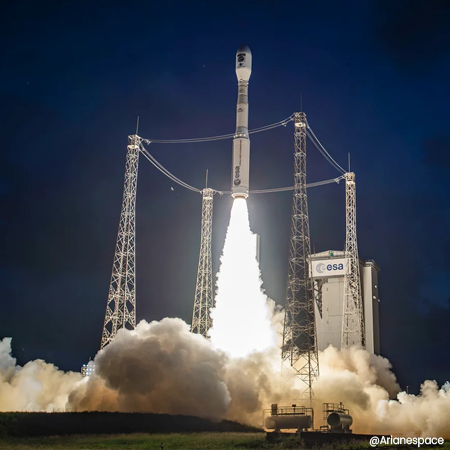
Vega-C, an evolution of the Vega launcher, represents Europe’s response to the need for independent and reliable access to space. With greater payload capacity and flexibility than its predecessor, Vega-C is positioned in a strategic range for the launch of small to medium satellites into sun-synchronous orbit.
After its maiden flight in 2022 and some technical difficulties, the launcher has successfully returned to operation:
- On December 5, 2024, Vega-C launched the Sentinel-1C satellite, part of the European Union’s Copernicus program. The satellite, equipped with a C-band synthetic aperture radar, will provide data for environmental monitoring, urban planning, natural disasters, and climate change. This flight (VV25) marked the launcher’s operational return.
- On April 29, 2025, Vega-C successfully launched Biomass, a satellite from ESA’s Earth Explorer series dedicated to measuring the carbon stored in the world’s forests. Biomass, built by Airbus, represents a milestone in climate change research, being the first satellite with P-band radar capable of penetrating the forest canopy to analyze its height, structure, and changes over time.
Questi successi non solo riaffermano la centralità di Vega-C nella strategia ESA per l’osservazione della Terra, ma anche il ruolo fondamentale del settore industriale europeo e italiano nel garantire autonomia spaziale al continente.
The role of Italian industry and the contribution of Insul.Tecno Group
Behind the success of the Vega-C lies a complex and highly specialized industrial supply chain. Italy, through Avio, leads the launcher’s design and production, but is supported by a network of qualified suppliers who guarantee the quality and performance of individual components.
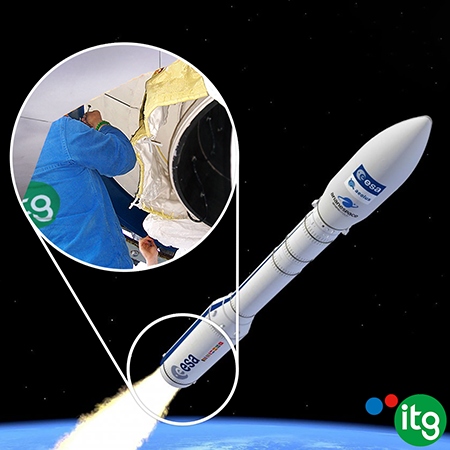
Among these, Insul.Tecno Group provided key materials for the Vega-C launcher’s structures and insulation. The company’s experience in advanced materials significantly contributed to the thermal resistance, lightweighting, and reliability of the components involved in the critical phases of flight. In particular, the supply of materials for thermal insulation and passive protection of the structures ensured the launcher’s stability during the initial thrust phases, when temperatures and mechanical stresses reach extreme levels.
Insul.Tecno Group’s involvement in a strategic project like Vega-C represents a virtuous example of integration between the Italian manufacturing industry and European space programs. Furthermore, it strengthens the company’s visibility and competitiveness in the rapidly expanding aerospace sector.
Conclusions
The Vega-C program confirms its position as a key asset for European space sovereignty and for promoting a new generation of scientific, environmental, and commercial missions. Despite strategic uncertainties regarding light launchers, Italy can claim a leading role thanks to its experience with Vega and the contribution of its industry.
The contribution of companies like Insul.Tecno Group demonstrates that the national industrial sector is not only capable of participating in technologically advanced projects but also capable of strengthening Italy’s presence in major European consortia. In a period of heightened competition, with emerging private players and new launchers under development, investing in innovation, materials, and expertise will be crucial to maintaining a leading role in access to space.
Useful links
Vega-C news: https://www.arianespace.com/updates-en/update-search/?filter=vega-c
3M™ Nextel™ 312 e 440 Technical data: https://multimedia.3m.com/mws/media/1242135O/3m-nextel-ceramic-fabrics-312-and-440.pdf
3M for aerospace: https://www.3m.co.uk/3M/en_GB/aerospace-emea/
Intro
Mini-IRENE (Italian Re-entry NacellE) is an experimental capsule developed as part of the IRENE program, an Italian initiative co-funded by the Italian Space Agency (ASI) and the European Space Agency (ESA), with the aim of testing an innovative atmospheric reentry system. It is the first European reentry experiment with a deployable, umbrella-shaped heat shield, combining reliability, lightness, and low cost.
The project was born from an entirely Campania-based consortium composed of CIRA – Centro Italiano Ricerche Aerospaziali (project coordinator), the Federico II University of Naples, the ALI Scarl consortium, and associated companies (Lead Tech, Euro.soft, SRS ED). The experimental launch took place successfully on November 23, 2022, from the Esrange base in Kiruna, Sweden, in collaboration with the Swedish Space Corporation (SSC).
Objectives and Technological Characteristics
The primary purpose of the Mini-IRENE mission is the in-flight qualification of the deployable Thermal Protection System (TPS), designed for return missions from low-Earth orbit (LEO), such as payload recovery from the ISS or future scientific missions.
Key features of the IRENE system:
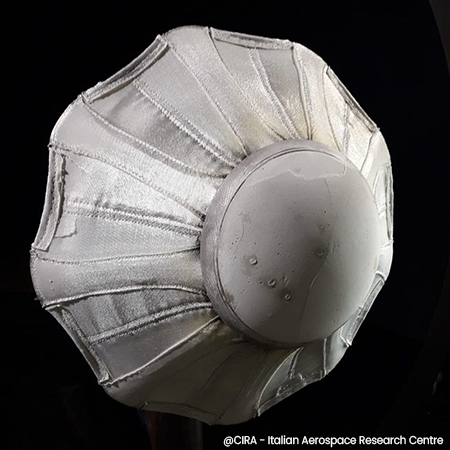
- Deployable umbrella-shaped heat shield, composed of a ceramic nose and a multilayer ceramic fabric airbrake.
- Low weight (approximately 15 kg) and compact diameter (29 cm closed, 1 meter open).
- Automatic deployment at an altitude of approximately 250 km, with controlled suborbital reentry.
- Low ballistic coefficient, allowing for a soft impact without additional deceleration systems.
- Technology is based on conventional, commercially available materials to keep costs low.
This innovative architecture allows for stable reentry, minimizing thermal and mechanical loads, and guarantees a safe landing with a low-velocity impact.
Development and Qualification Campaign
The project required over ten years of research and development and was divided into several phases:
- Design and simulation
- Fluid dynamics (CFD) analyses to evaluate the optimal shield configuration.
- Finite Element Method (FEM) studies to validate the mechanical stability of the telescopic structures.
- Definition of the optimal ballistic profile for atmospheric reentry.
- Ground tests
- Thermal testing campaigns in the CIRA Scirocco and Ghibli plasma tunnels.
- Tests in the Space Qualification Laboratory to simulate the extreme conditions of reentry.
- Launch and recovery
- The launch took place aboard a VSB-30 sounding rocket equipped with a two-stage propulsion system.
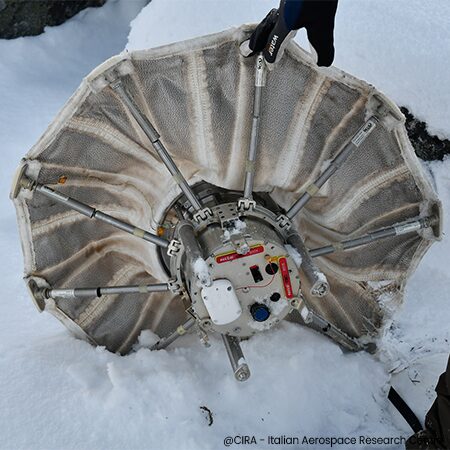
- The capsule was released at an altitude of approximately 250 km, activated the shield deployment, and performed a stable descent until recovery.
- The successful recovery allowed for post-flight analysis, confirming the proper functioning of all subsystems, including the separation mechanism, heat shield integrity, and flight data collection.
Industrial Contribution
Among the industrial companies involved, a key role was played by Insul.Tecno Group, an Italian company specializing in high-performance materials for insulation and thermal protection.
Insul.Tecno Group supplied highly specialized materials for the Mini-IRENE capsule’s multilayer heat shield, significantly contributing to the structural strength of the TPS during the most critical phases of reentry. This technological support was a key component of the mission’s success and demonstrates the Italian industry’s ability to meet highly complex aerospace challenges.
Results and Future Prospects
The successful flight of Mini-IRENE represents a key milestone for European atmospheric reentry technology. The tested solutions offer numerous advantages:
- Reduction in mass and cost compared to traditional systems.
- Modularity and mechanical simplicity.
- Potential reuse of the concept in future larger or manned versions.
This initial demonstration now forms the basis for further developments, including the development of the IRENESAT-Orbital minisatellite and future operational missions for sample collection, robotic missions, and Earth observation.
As emphasized by Antonio Blandini, President of CIRA, “the success of Mini-IRENE is the result of a highly integrated supply chain in Campania, capable of developing cutting-edge space technologies.“
Conclusions
Mini-IRENE is intended as a strategic technology demonstrator for the future of European space missions. Its entirely Italian development demonstrates the ability of the national research and industrial system to produce concrete innovation in the space sector. Combining efficiency, reliability, and cost containment, IRENE technology opens up new possibilities for commercial, scientific, and institutional applications in space.
Useful links
CIRA Article: https://www.cira.it/en/space/accesso-allo-spazio-satelliti-ed-esplorazione/mini-irene
Publication: https://www.researchgate.net/figure/Mini-Irene-Ground-Demonstrator_fig8_308333895
Space Factory Article: https://www.spacefactorysrl.it/sistemi-di-rientro/
3M™ Nextel™ 312 e 440 Technical data: https://multimedia.3m.com/mws/media/1242135O/3m-nextel-ceramic-fabrics-312-and-440.pdf
3M for aerospace: https://www.3m.co.uk/3M/en_GB/aerospace-emea/
Introduction
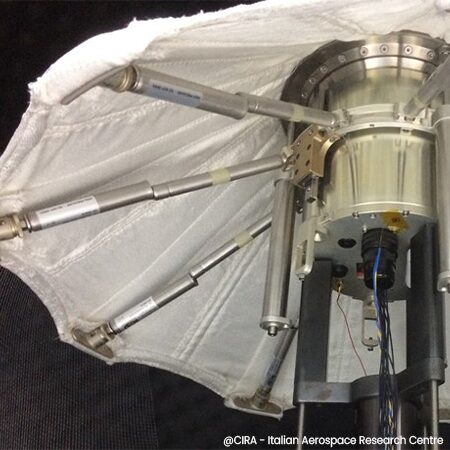
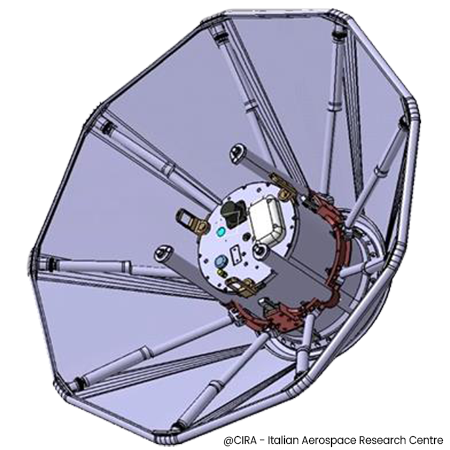
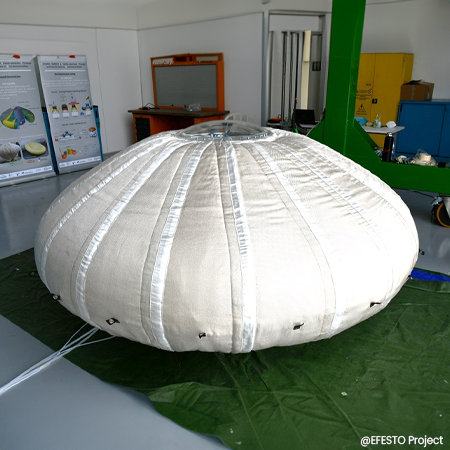
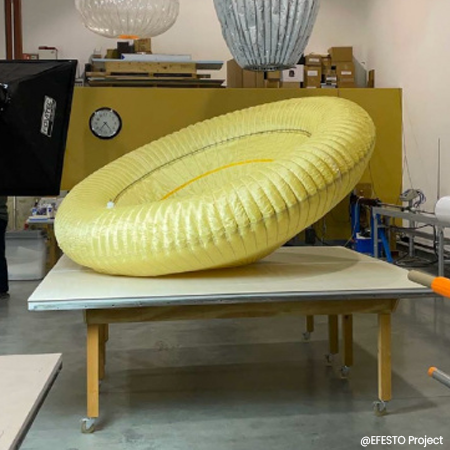
The EFESTO-2 project, the natural successor to the EFESTO project (H2020 grant 821801), represents a major step forward in the development of European technologies for Inflatable Heat Shields (IHS), which are essential for protecting spacecraft during atmospheric reentry. The project is funded under the Horizon Europe program (grant agreement No. 1010811041) and meets the objectives of the call “HORIZON-CL4-2021-SPACE-01-23“, dedicated to reentry and descent systems.
Building on the significant results achieved by EFESTO, EFESTO-2 aims to consolidate and expand knowledge and simulation models in the IHS field, increasing its TRL (Technology Readiness Level) from 4-5 to 5-6.
Objectives and Pillars of the Project
EFESTO-2 is based on four key pillars:
- Business case analysis to identify significant space applications of IHS.
- Extension of studies already underway in the EFESTO project to critical aspects not yet explored.
- Increased reliability of numerical tools, models, and technical expertise.
- Continuous support for the IHS sector in Europe, strengthening scientific and industrial involvement.
Specifically, the development of IHS opens up new perspectives for commercial space transportation, offering solutions for the recovery and reuse of launch stages, ISS cargo modules, and reusable satellites. Furthermore, the application of these devices in the de-orbiting phase meets the objectives of the European Green Deal, helping to reduce dependence on chemical propulsion and the environmental impact of space debris.
Technical Structure of the Project
The project is divided into five main components:
- Business Case Analysis (BCA)
The analysis allowed us to select the most promising use case, guiding the definition of the reference system, which includes scenarios such as the recovery of launch stages, cargo capsules, and satellites. - Design Definition
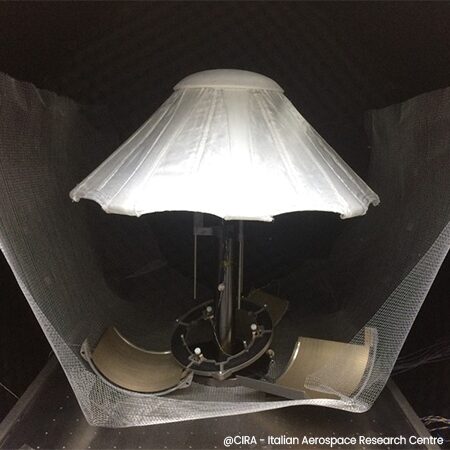
This includes the development of mission and system architecture, trajectory analysis, aerodynamic and aerothermodynamic studies, and preliminary definition of the flexible TPS and inflatable structure. An iterative cycle of CFD-FEM numerical analyses is planned to evaluate fluid-structure interaction (FSI) and validate the system’s behavior. - Test Campaign
The tests focus on aerodynamic stability in the wind tunnel and the mechanical characterization of the 1:2 scale demonstrator. These activities are essential for exploring dynamic phenomena and validating the materials and structural models. - Numerical-Experimental Correlation
The goal is to compare test results with numerical models to increase their reliability. Updates include the three-dimensional modeling of the inflatable structure, the Flying Quality Assessment, and the simulation of the inflation process in 0-g and 1-g environments. - Technology Assessment and Roadmapping
An evaluation of the achieved TRL will be conducted, with the definition of a roadmap towards TRL 7-8, including numerical verification, ground testing, and flight testing. Cost estimates for the operational implementation of IHS technology will also be included.
Industrial Contribution: The Role of Insul.Tecno Group
A key element to the success of the EFESTO-2 project was the support of companies specializing in the supply of advanced materials. Among these, Insul.Tecno Group played a significant role, contributing 3M™ Nextel™ materials, used in critical components of the Flexible Thermal Protection System (F-TPS).
These high-performance ceramic materials are essential for withstanding the extreme temperatures and mechanical stresses of atmospheric reentry. Collaboration with Insul.Tecno Group ensured the availability of reliable solutions, strengthening the European industrial supply chain for reentry technologies.
Conclusions
EFESTO-2 represents a strategic step toward European autonomy in the development of inflatable heat shields. The project integrates scientific, technological, and industrial expertise to develop innovative solutions for sustainable space reentry, with application prospects in both the institutional and commercial sectors.
The synergy between research institutions, industries, and specialized suppliers—such as Insul.Tecno Group—has enabled concrete results and a clear path toward the operational adoption of IHS, reducing costs, risks, and environmental impact in the context of the new European space economy.
Useful links
EFESTO Project: http://www.efesto-project.eu/
3M™ Nextel™ 312 e 440 Technical data: https://multimedia.3m.com/mws/media/1242135O/3m-nextel-ceramic-fabrics-312-and-440.pdf
3M for aerospace: https://www.3m.co.uk/3M/en_GB/aerospace-emea/
Introduction
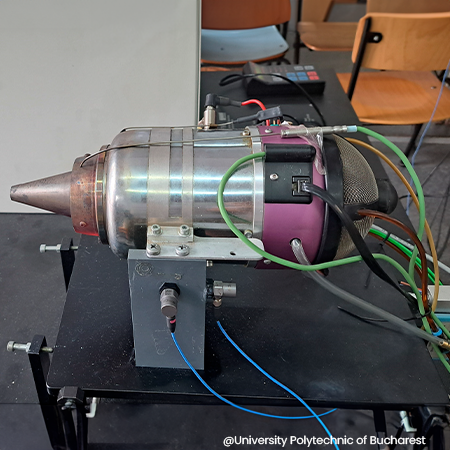
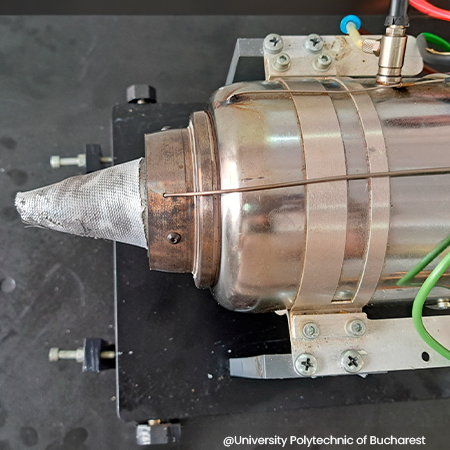
The growing focus on reducing noise pollution in aerospace propulsion systems, particularly drones and microturbojets, is pushing for lightweight, passive, and easily integrated solutions. In this context, a research team from the Technical University of Bucharest and the National Institute for Gas Turbines (COMOTI) tested an innovative approach: the use of a 3M™ Nextel™ 312 ceramic fabric coating applied to the central cone of a microturbojet exhaust nozzle.
Objective of the Study
The study compares the acoustic performance of three configurations:
- Basic configuration (without treatment)
- Nozzle with ejector (traditional noise reduction device)
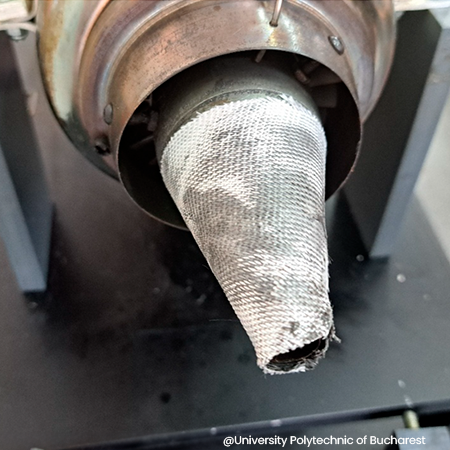
- Nozzle coated with Nextel™ 312 ceramic fabric
The objective was to verify whether a lightweight ceramic coating could provide significant noise reduction, especially under high thrust conditions, without substantially modifying the nozzle geometry.
The Material: 3M™ Nextel™ 312
Nextel™ 312 fabric is composed of continuous polycrystalline oxide fibers (62.5% Al₂O₃, 24.5% SiO₂, 13% B₂O₃), with a density of 2.8 g/cm³ and a thermal resistance of up to 1200°C. Thanks to its porous microstructure and low density, it is able to dissipate acoustic energy through internal reflection, viscous damping, and dispersion.
The fabric was applied to the central cone of the nozzle with BISON Fireplace Sealant, a refractory sealant that ensures reliable adhesion up to 1250°C.
Method and Results
The tests were performed on a JetCat P80 engine operating at three speeds (from 35,000 to 112,600 RPM). Acoustic behavior was evaluated with a network of five microphones arranged in an arc 1 meter from the jet outlet.
Main results:
- The Nextel™ coating effectively reduced high-frequency noise, with particularly significant benefits for acoustic protection near the source.
- Unlike the ejector, the coating does not alter the engine geometry or require additional components.
- The average sound pressure level (OASPL) reduction was comparable to that achieved with the ejector, with a more uniform distribution of acoustic energy.
- Proper Orthogonal Decomposition (POD) analysis showed that Nextel™ fabric redistributes sound energy more evenly, reducing localized concentrations.
Impact and Applications
Nextel™ ceramic fabric coating represents an innovative, lightweight, and modular solution for passive noise control in compact propulsion systems. It is particularly suitable for:
- Drones and UAVs
- Ground test engines
- Systems where weight, simplicity, and space are critical
Although subject to thermal degradation after a single operating cycle, the material is designed as a low-impact, replaceable component.
Contribution of Insul.Tecno Group Srl
The success of the study was also possible thanks to the contribution of Insul.Tecno Group Srl, a company based in Binasco (MI), which supplied the Nextel™ 312 ceramic fabric samples used in the tests. The company also managed international logistics, making a significant contribution to the feasibility of the project.
Conclusions
The Nextel™ 312 coating has proven to be a valid alternative to traditional ejectors for noise reduction in microturbojets. Its effectiveness, combined with its ease of use and negligible weight, opens new perspectives for the integration of passive solutions in future propulsion systems.
Useful links
Article published on the Q1 Journal platform: https://www.mdpi.com/2227-7080/13/7/295
3M™ Nextel™ 312 e 440 Technical data: https://multimedia.3m.com/mws/media/1242135O/3m-nextel-ceramic-fabrics-312-and-440.pdf
3M for aerospace: https://www.3m.co.uk/3M/en_GB/aerospace-emea/